Optical Telescopes Are Usually Used Only at Night, but Radio Telescopes Can Be Used Day or Night.
ESO'south Very Large Telescope (VLT) is a flagship facility for European ground-based astronomy. Information technology is one of the world'south most advanced optical telescopes, consisting of four Unit of measurement Telescopes with main mirrors of 8.2m bore and four movable one.8m diameter Auxiliary Telescopes. The telescopes can work together, to form a giant 'interferometer', the ESO Very Large Telescope Interferometer, assuasive astronomers to pick upwards much finer details of the cosmos than would be possible with the ATs or the UTs alone.
The eight.2m bore Unit of measurement Telescopes tin also exist used individually. With ane such telescope, images of celestial objects as faint every bit magnitude 30 tin exist obtained in a ane-hour exposure. This corresponds to seeing objects that are 4 billion (four thousand one thousand thousand) times fainter than what can be seen with the unaided eye.
The large telescopes are named Antu, Kueyen, Melipal and Yepun.
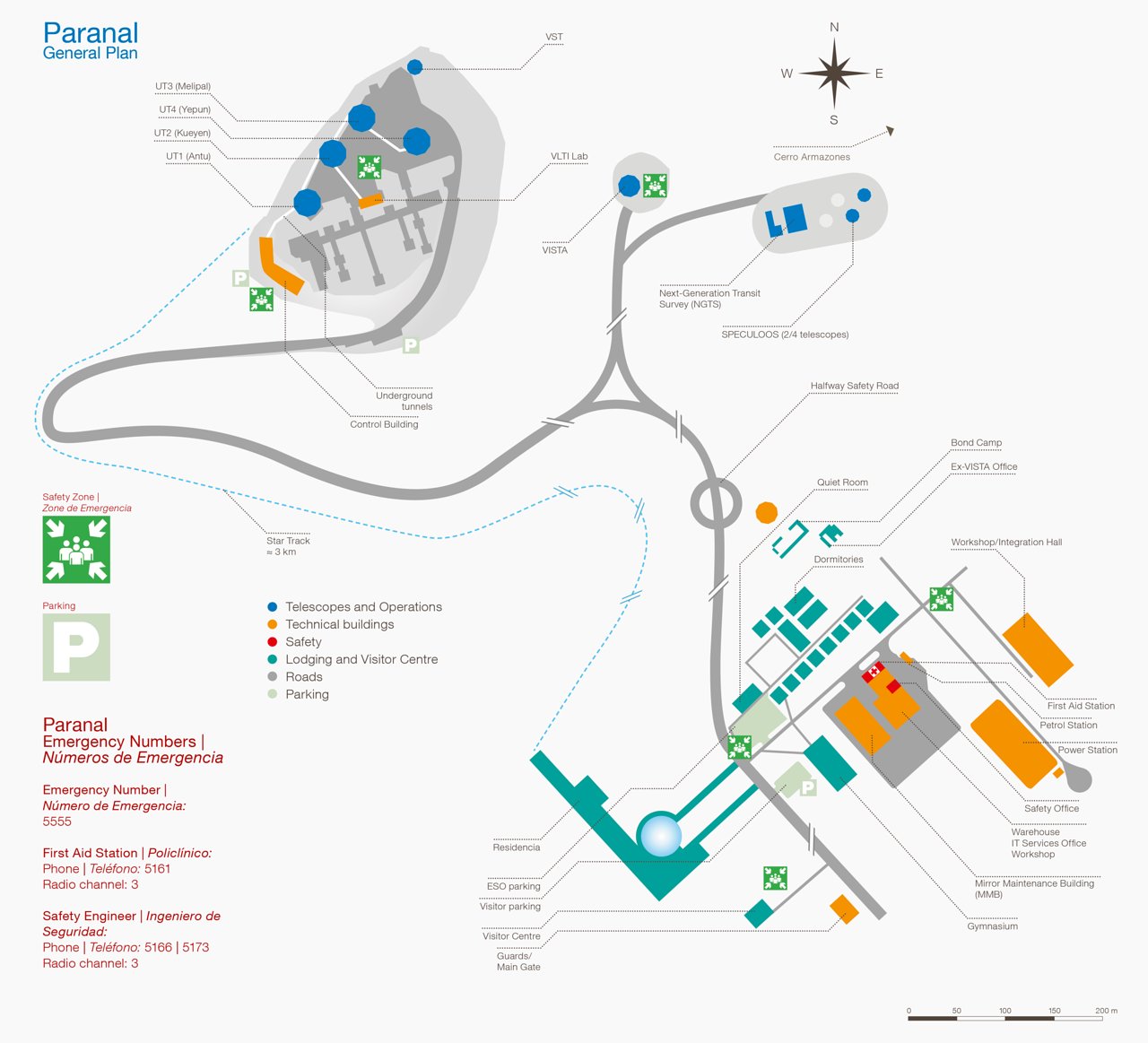
Paranal map and rubber. Credit: ESO
Webcam
LIVE
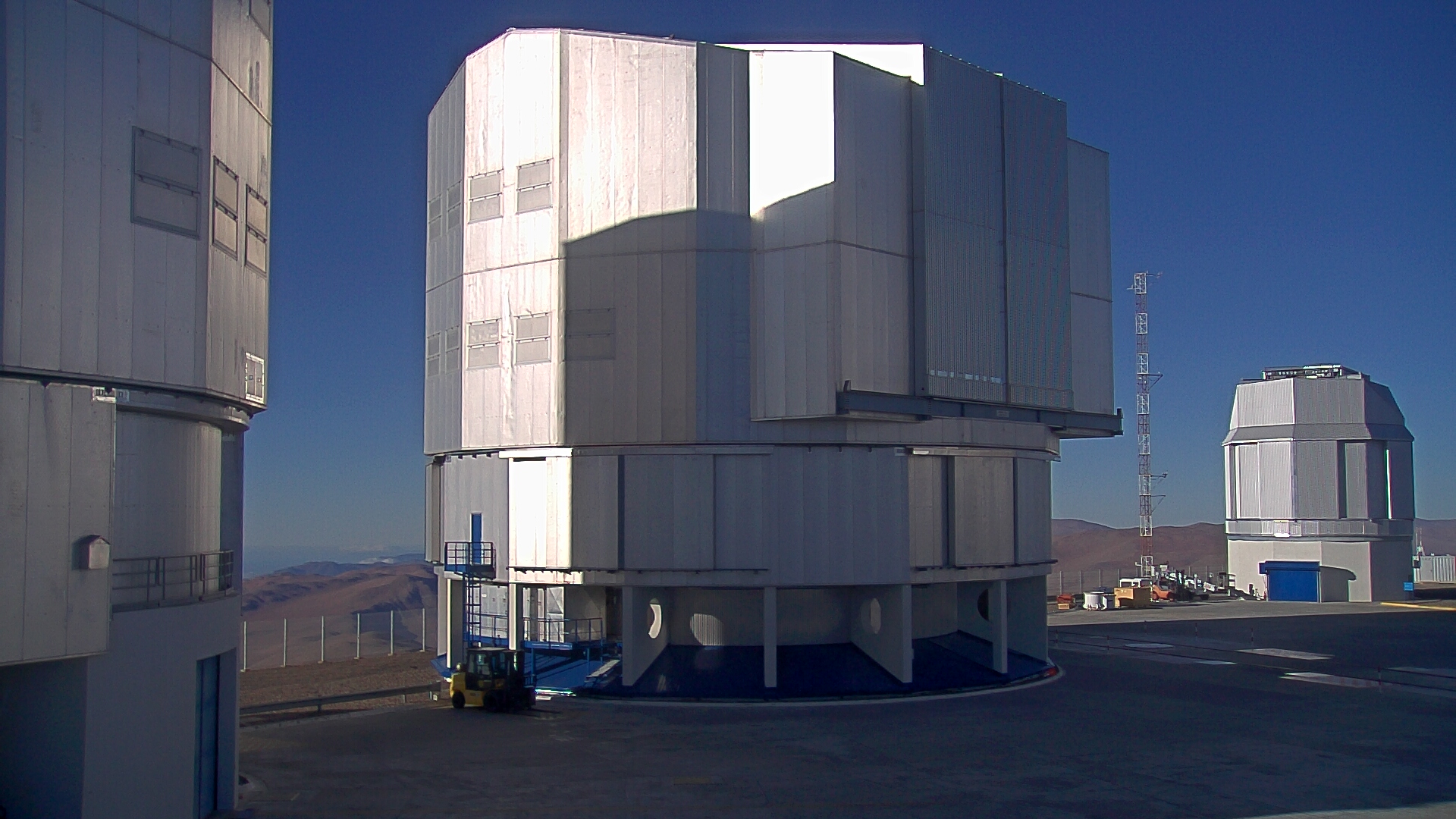
Latest available image of MELIPAL, also known as UT3 ()
Alive
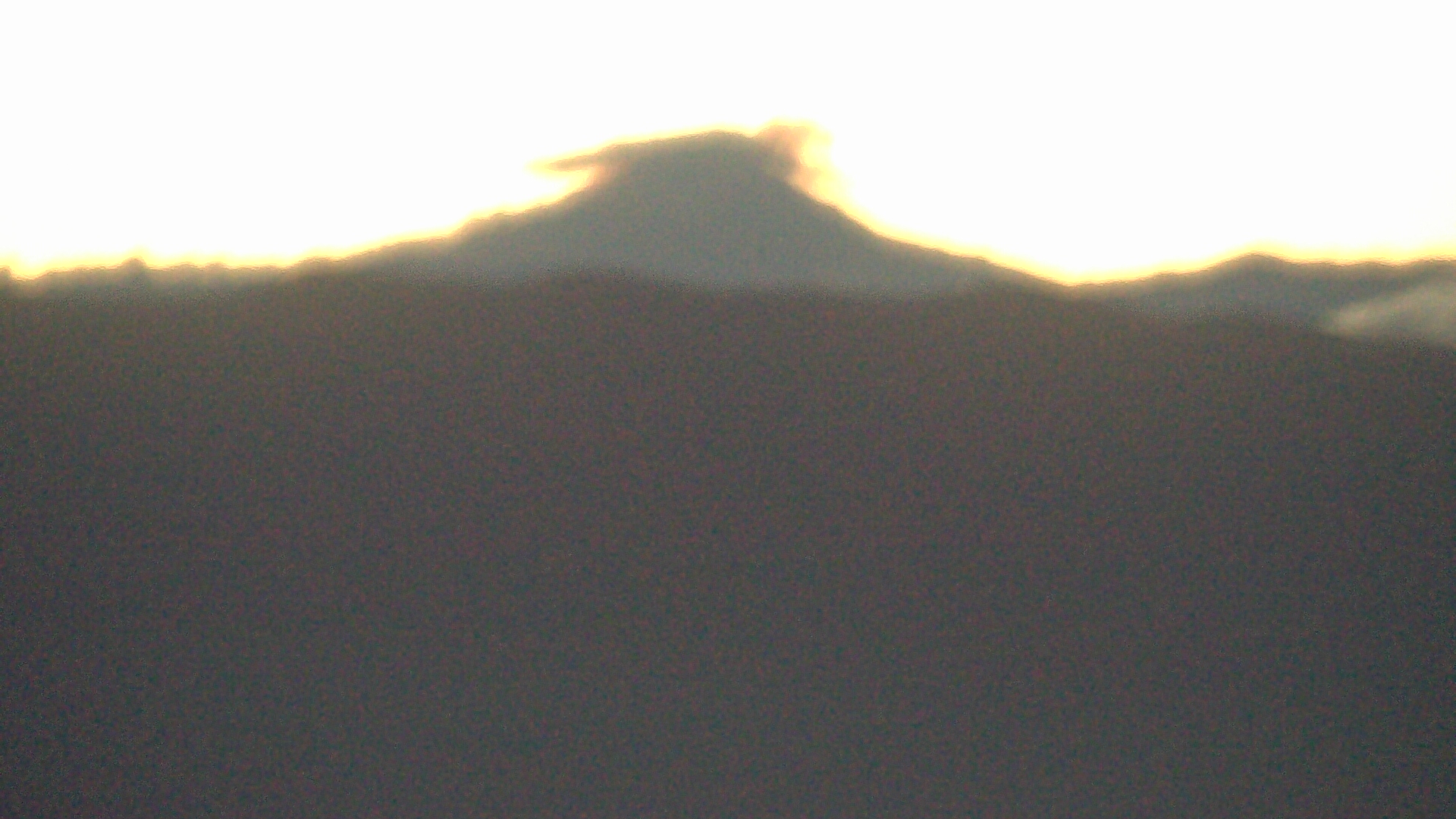
On extremely clear days the magnificent 6739-metre volcano Llullaillaco is visible in the background of this photograph. It is an astonishing 190 kilometres abroad on the edge with Argentina. ()
| LIVE Circular fisheye | Live Extra deep night-time circular fisheye. NB: merely live at night. |
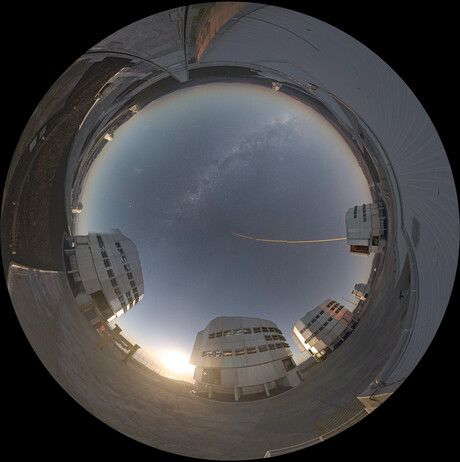
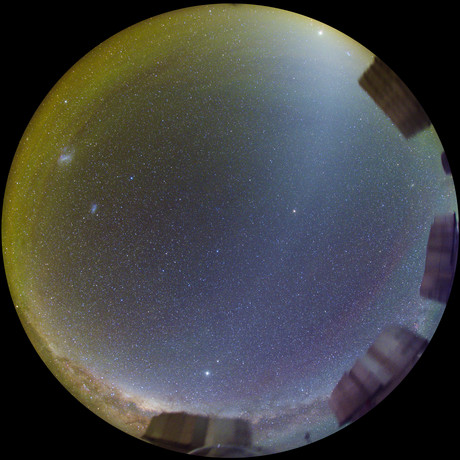
A Tour at Paranal Observatory
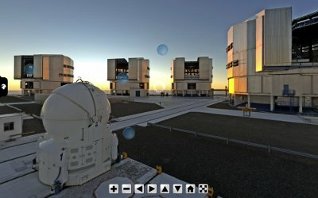
Click on the image to take a Virtual Tour in and nearby the VLT.
Visit Paranal Observatory
- Journalists, science writers and producers, please come across Media Visits
- Tourist, students and lay people, please encounter Tourists and Students Visits
Telescopes and Instruments
The VLT instrumentation programme is the most aggressive programme ever conceived for a single observatory. Information technology includes large-field imagers, adaptive optics corrected cameras and spectrographs, as well as high-resolution and multi-object spectrographs and covers a broad spectral region, from deep ultraviolet (300 nm) to mid-infrared (24 µm) wavelengths.
The Unit Telescopes
The viii.2m diameter telescopes are housed in compact, thermally controlled buildings, which rotate synchronously with the telescopes. This design minimises any adverse effects on the observing conditions, for instance from air turbulence in the telescope tube, which might otherwise occur due to variations in the temperature and wind flow. The beginning of the Unit Telescopes, 'Antu', went into routine scientific operations on i Apr 1999. Today, all 4 Unit Telescopes and all four Auxiliary Telescopes are operational.
VLT Unit Telescope enclosures:
- Height: 2850 cm
- Diameter: 2900 cm
The Auxiliary Telescopes
Although the iv 8.2-metre Unit Telescopes can be combined in the VLTI, they are mostly used for private observations and are only available for interferometric observations for a express number of nights every year. Just four smaller, dedicated 1.8-metre Auxiliary Telescopes (ATs) are available to allow the VLTI to operate every night.
More information is available on this link
Science with the Very Big Telescope
 The VLT has made an undisputed touch on on observational astronomy. It is the nearly productive individual ground-based facility, and results from the VLT have led to the publication of an boilerplate of more than than 1 peer-reviewed scientific newspaper per day. VLT contributes profoundly to making ESO the near productive footing-based observatory in the world. The VLT has stimulated a new historic period of discoveries, with several notable scientific firsts, including the get-go image of an extrasolar planet (eso0428), tracking individual stars moving effectually the supermassive blackness hole at the centre of the Milky way (eso0846), and observing the afterglow of the furthest known Gamma-Ray Burst.
More about Science with the VLT
- Science with ESO Telescopes
- ESO Top 10 Astronomical Discoveries, n° ane, three, 5, 6, seven, 8 (also available as presentation)
More about the Very Large Telescope
- More interesting facts are available on the FAQs page
- More images and videos are available in the ESO multimedia archive
- Read more than on about this telescope on the VLT Handout in PDF format
- For Scientists: for more than detailed information, delight see our technical pages
- More than detailed background and technical information is provided in the VLT Whitebook
Residencia
The VLT hotel, the Residencia, is an award-winning building, and served as a backdrop for office of the James Bail picture Breakthrough of Solace.
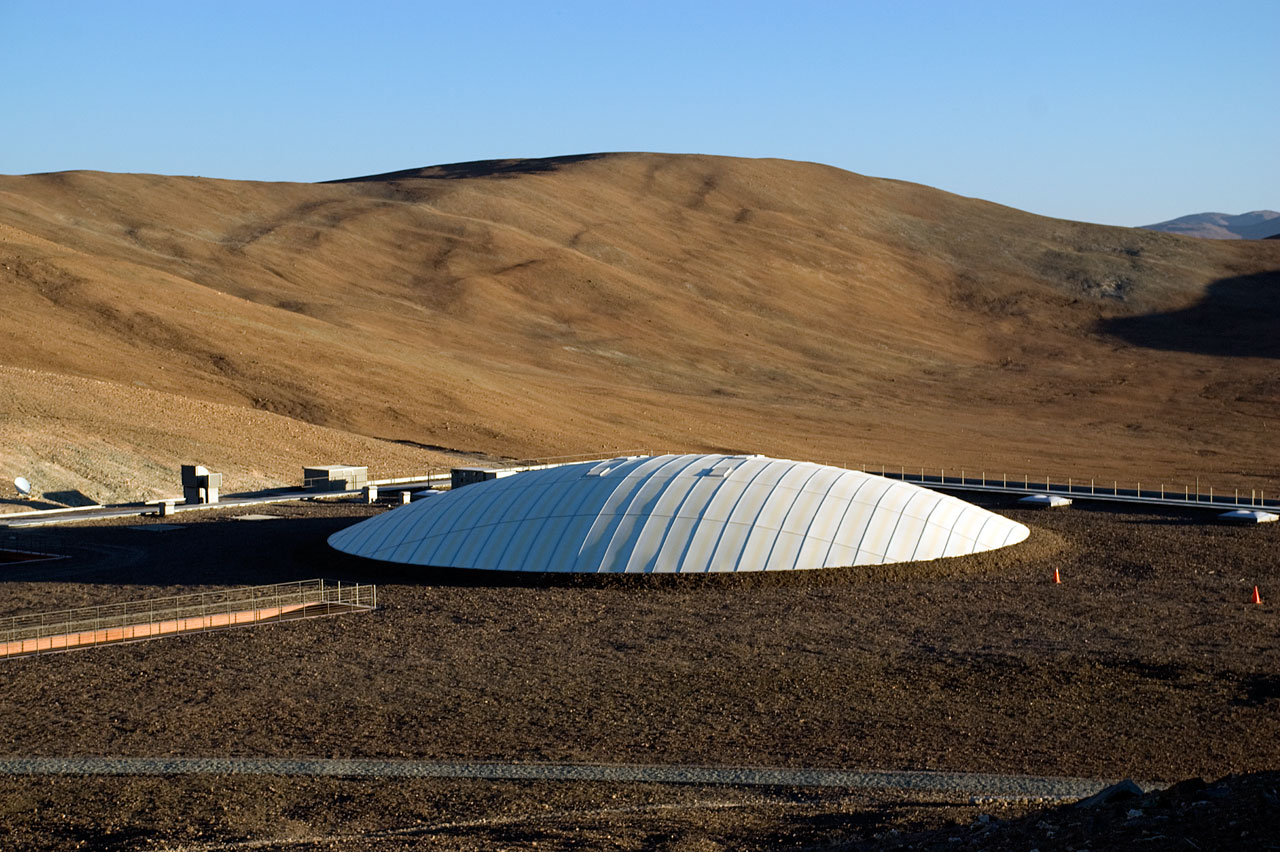
The VLT Trailer
Download the VLT trailer in the video archive.
VLT
| Name: | Very Large Telescope |
| Site: | Cerro Paranal |
| Altitude: | 2635 m |
| Enclosure: | Compact optimised cylindrical enclosure |
| Type: | Optical/infrared, with interferometry |
| Optical pattern: | Ritchey-Chrétien reflector |
| Diameter. Principal M1: | 8.20 m |
| Material. Primary M1: | ZeroDur |
| Diameter. Secondary M2: | 0.94 m |
| Material. Secondary M2: | Beryllium |
| Bore. 3rd M3: | one.242 x 0.866 m (elliptical flat) |
| Mount: | Alt-Azimuth mountain |
| Commencement Lite date: | UT1, Antu: 25 May 1998 UT2, Kueyen: 1 March 1999 UT3, Melipal: 26 Jan 2000 UT4, Yepun: iv September 2000 |
| Active Optics: | Yeah |
| Adaptive Optics: | UT4: Light amplification by stimulated emission of radiation Guide Star + SINFONI UT1: NACO UT3: SPHERE |
| Interferometry: | UT maximum 130 m baseline. UT + AT maximum 140 m baseline. |
| Images taken with the VLT: | Link |
| Images of the VLT: | Link |
| Videos of the VLT: | Link |
| Press Releases with the VLT: | Link |
Did y'all know?
The smallest detail distinguishable with the VLT'southward adaptive eyes organisation is smaller than the size of a DVD on the International Space Station, as seen from the ground (nearly 50 milliarcseconds).
Did you know?
The smallest particular distinguishable with the VLTI is most the size of a sesame seed on the International Space Station, as seen from the footing (about ii milliarcseconds).
Did you know?
Stars form in dense clouds of the interstellar medium, but even in these densest regions the pressure level is comparable to the nigh tenuous vacuum created in a laboratory on World. In these clouds, the temperatures are below -200 degrees Celsius.
Did you lot know?
When astronomers combine the light waves from two telescopes using the principle of interferometry, they can very precisely make up one's mind the direction of an object in space. Your ears work in a similar way to localise sounds, by comparing the sound received at the left and right ears.
Did y'all know?
The skies over the ESO sites in Chile are so night that on a clear moonless night it is possible to see your shadow cast by the light of the Galaxy alone.
Did y'all know?
The VLT viii.ii-metre bore primary mirrors were polished and so precisely that if they were scaled upwards to the diameter of the World, the largest imperfection on them would still be no larger than a pebble.
Did you know?
The VLT mirrors are viii.two metres in bore, only only 17.v cm thick — very thin relative to their size. If you scaled the mirror down to the size of a CD, its thickness would exist equivalent to just two discs placed on height of each other. Despite being very thin, the large bore ways the glass weighs 23 tonnes.
Did you know?
The movable structure of each VLT Unit Telescopes weighs well-nigh the same as a fully loaded jumbo jet. However, it is so perfectly balanced, resting on hydrostatic oil-film bearings, that the behemothic telescopes can be moved by hand.
Did you know?
The Paranal observatory site is so remote that everything needed must be brought in specially. The 60 000 litres of water that are used per day are delivered by truck from Antofagasta.
Source: https://www.eso.org/public/teles-instr/paranal-observatory/vlt/
0 Response to "Optical Telescopes Are Usually Used Only at Night, but Radio Telescopes Can Be Used Day or Night."
Postar um comentário